photographers’ gallery企画 宮森敬子展 “No matter what, I am still a part of it. (それでも、私は世界の一部としてある) ” 2026.1.9 – 2026.1.18 12:00 - 20:00 会期中無休/DAILY OPEN
“ひとつの存在は、小さな部分であり、どこかにそっとはまる《鍵》となる。私の存在も、より大きなものの部分にすぎない。”

本展では、2021年より継続している長期プロジェクト《TIME》と、新作インスタレーション《No matter what, I am still a part of it. 》を発表します。
《TIME》は、宮森が日々採取している樹拓を、小さなガラス箱に封じ続けているプロジェクトです。今回の展示では、1,000 日分の《TIME》として、1,000 個のガラス箱が積み上げられることで、時間の堆積が立体的に現れます。また、1 日目から1,000 日目までのプロジェクト全体を収めた写真も、大きな時間の景観として提示されます。
これら二つの作品は、「時間」と「空間」の概念を塊と散りばめによって見せていることにおいて対照的ですが、ともに断片が全体の一部である点において共通しています。そして、手のひらに乗るほどのこれら小さな断片は、どんな儚い存在も大きなものに繋がり、また影響を与える鍵となり得ることを静かに示唆しています。
▼展示内容
《TIME》和紙、木炭、半田、ガラス(1,000点・各6.5×8.5×1.2cm)
《No matter what, I am still a part of it. 》和紙、木炭、半田、ガラス
協力/Gallery Camellia
-
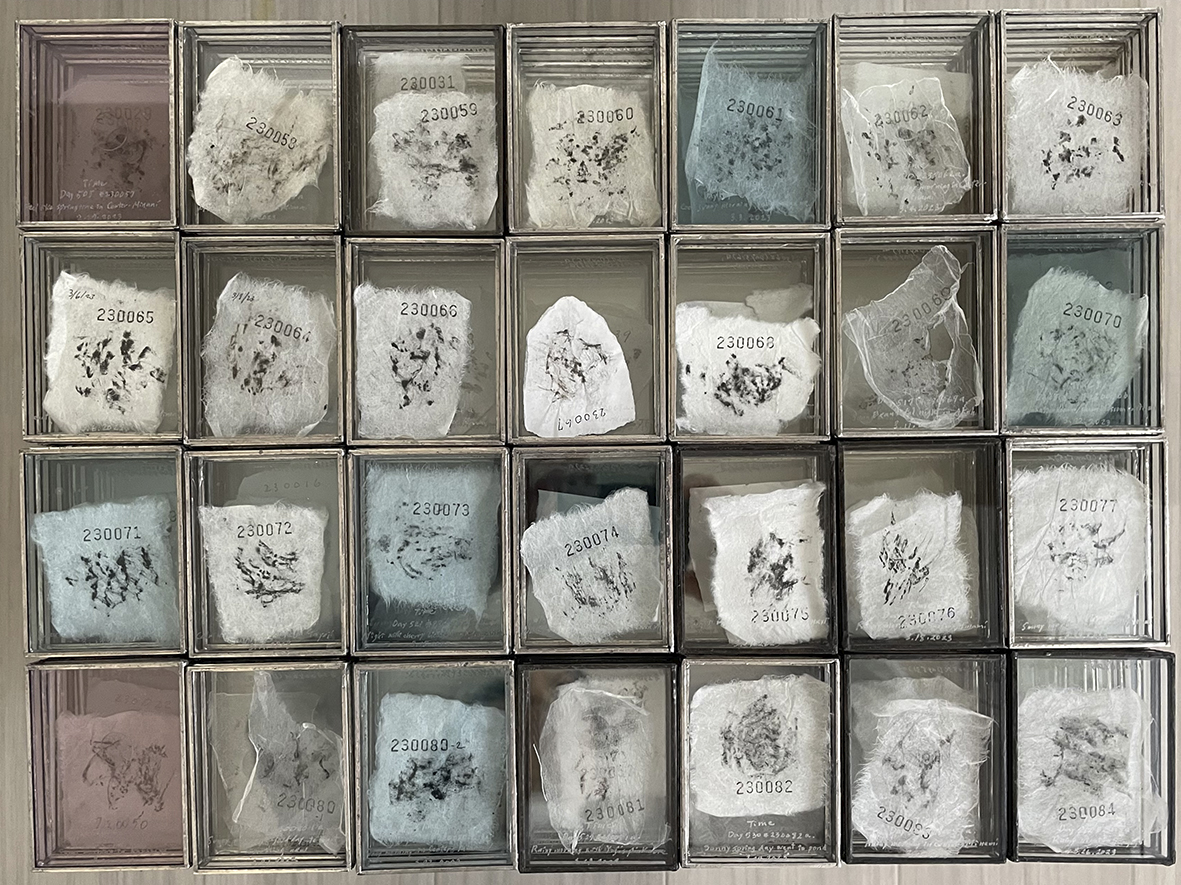 《TIME》Day 505-532
 -
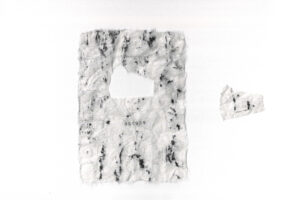
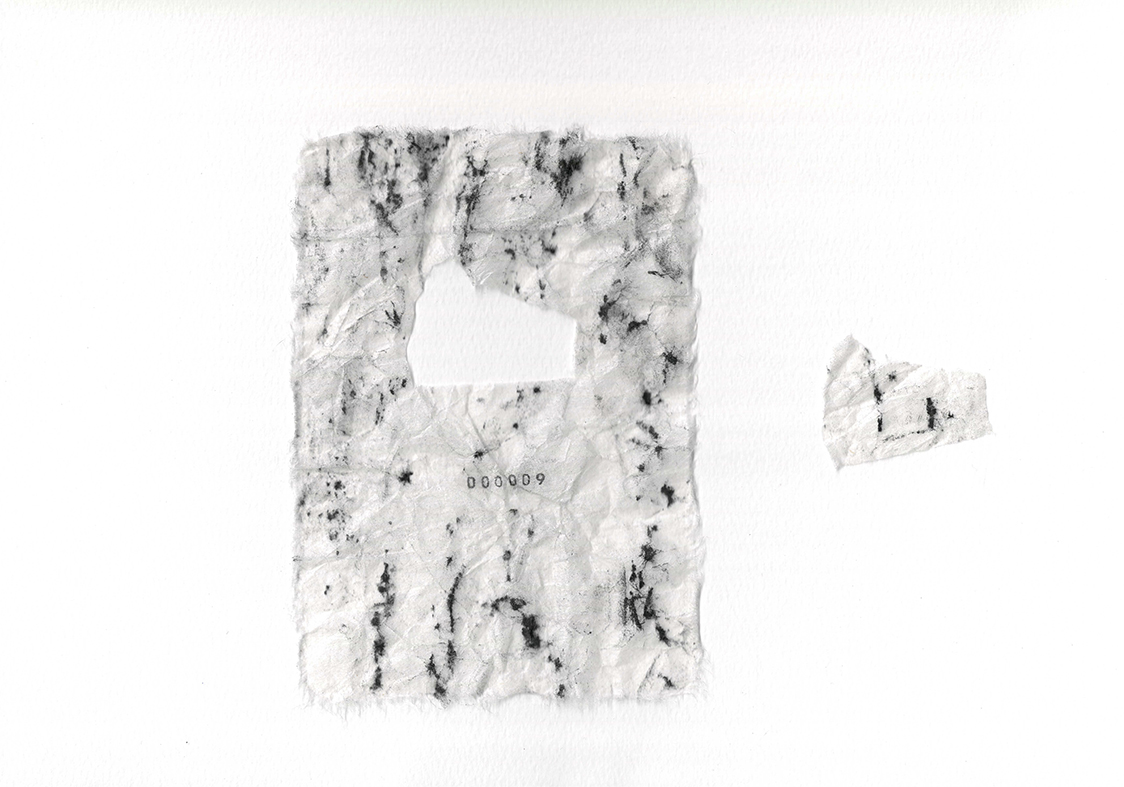 《No matter what, I am still a part of it.》Day9
 -
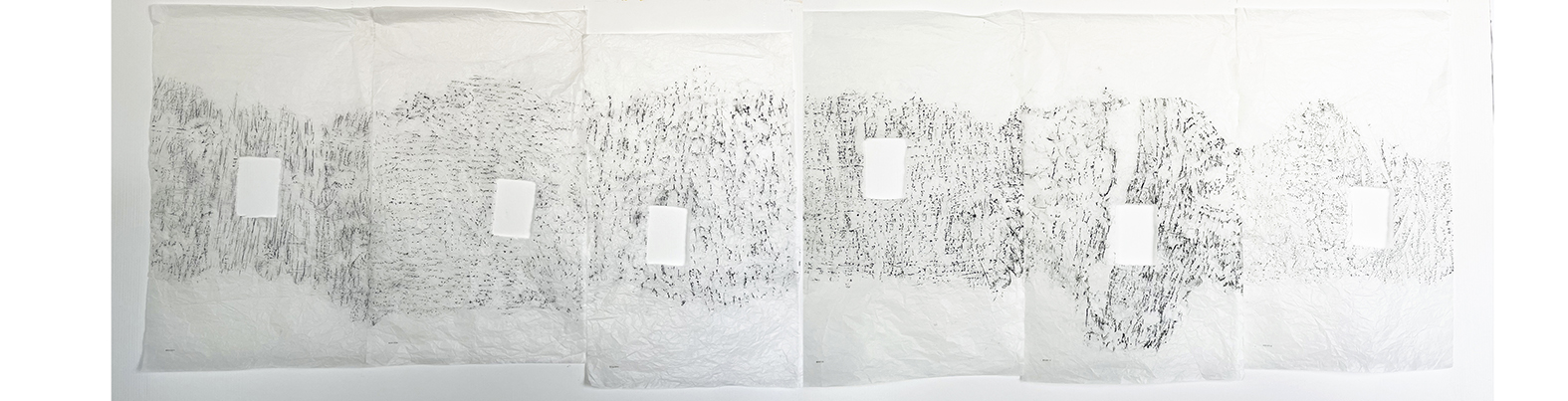 《No matter what, I am still a part of it.》Day7-8-9-10-11-12
▼関連イベント:上映イベント+アフタートーク
日時:1月17日(土)18時〜
場所:photographers’gallery
定員:25名(要予約)
入場料:1,000円
主催:photographers’ gallery
予約:https://coubic.com/pgshop/2028615
◎ドキュメンタリー映画「海でなくてどこに」について 大澤未来
2016年、オーストラリア・メルボルンでユダヤ史研究者・菅野賢治が、第二次世界大戦期のジェノサイドを免れた元ユダヤ難民マリアと出会ったことがきっかけとなり、本作は生まれました。1939年9月、マリア・カム(旧姓ウェイランド、1920-2019)とマーセル・ウェイランド(1927年生まれ)は、ナチスのポーランド侵攻に伴い、家族(両親、弟、姉とその夫)とともに故郷の町ウッチを離れました。リトアニア・ヴィルニュスで、心もとない難民生活を15か月送ったのち、一家はシベリア鉄道に飛び乗り、ウラジオストックからは海路、日本へ。これを可能にしたのは、リトアニア・カウナス日本領事代理・杉原千畝が発給した通過ヴィザでした。冷たく荒れた日本海を渡り、たどり着いたのは福井県・敦賀港でした。その後、神戸に移った彼らが戦時中の日本に住むことは許されませんでした。日本占領下の上海へと流浪は続きますが、彼らはやがてシドニーとメルボルンに安息の地を見つけます。第二次大戦中に離れ離れになった姉弟の生き残りをかけた旅の軌跡から、それぞれの場所に遺る“忘れ去られた記憶”が浮かび上がります。ユダヤ人の離散の物語を通して、日本人、中国人、オーストラリア人が彼らと築いた関係性も見えてきます。故郷を離れざるを得なかった人々にとっての魂の拠り所とは……?現代の難民問題に通じる「ここではなくてどこに」という問いを、彼らの物語は私たちに突きつけます。
▼宮森敬子 MIYAMORI Keiko 略歴
1964年、神奈川県生まれ。筑波大学大学院芸術研究科日本画専攻修了。三木多聞賞受賞(1994)。文化庁新進芸術家海外留学制度により米国ペンシルべニア大学大学院在籍(1998)。2000 年よりフィラデルフィアで、2011年よりニューヨーク、近年は日本で制作している。作品は絵画、彫刻からインスタレーションに及び、現在は日本とアメリカを基盤に制作活動を行なっている。和紙や木炭を使い、異なる時間や場所に存在する自然や人工物の組み合わせを、個と全体のつながりに注目した作品を作っている。第6回柏市文化フォーラム104大賞展TAMON賞-谷新の眼大賞(1995)、第16回今立現代美術紙展大賞(1997),リーウェイ財団ウインドウオブオポチュニティー賞(2003)、The Frederik Meijer Sculpture Park Competition大賞(2004)、Leeway Foundation Transformation Award(2008)、センターフォーエマージングビジュアルアーティストトラベルグラント受賞(2009)、The Independence Foundation Fellowships in the Arts 受賞(2010)、朝日新聞文化財団助成(2018)。主な展覧会は、VOCA’97「現代美術の展望—新しい平面の作家達」(上野の森美術館/東京 、1997)、「拡兆する美術’97 」(つくば美術館/茨城、1997)、「流通と大地」(カスミつくばセンター/茨城、1998)などのグループ展に参加し、以降、アメリカ(フィラデルフィアやニューヨーク、ピッツバーグなど)を中心に日本、ドイツ、韓国などでのグループ展に多数参加。
◎宮森敬子web サイトhttps://www.keikomiyamori.com/
▼大澤未来 OSAWA Mirai 略歴
1981 年、東京都生まれ。映画美学校ドキュメンタリーコースにて筒井武文、佐藤真ほかに教えを受ける。在学中の監督作『帰郷−小川紳介と過ごした日々−』は山形国際ドキュメンタリー映画祭2005上映作品に選出。人類学、民俗学をベースに人間を中心とした世界の表象に偏ってきた映像表現を揺さぶるために、動植物や自然現象がもつ時間軸や視点を取り込み、映画とインスタレーションを発表。近年は八丈島を拠点に伊豆諸島シネマセンター代表として離島での活動も展開。主な監督作に『廻り神楽』(2017年)、『海でなくてどこに』(2021年)。主な展示作品に『彼らからの視線』(八戸市美術館、2021年)、『BE WATER』(富山県美術館、2022年)など。
◎大澤未来web サイトhttps://oosawamirai.com/
Keiko Miyamori Exhibition 「No matter what, I am still a part of it.」
Dates: January 9 (Fri) –18 (Sun), 2026
Venue: photographers’ gallery (Shinjuku, Tokyo)
Organized by: photographers’ gallery
Supported by: Gallery Camellia
“A single existence is a small fragment, a key that quietly finds its place. My existence, too, is only a part of something deeper.” photographers’ gallery is pleased to present No matter what, I am still a part of it., a solo exhibition by Keiko Miyamori, an artist based in New York and Yokohama. Miyamori has long worked with jutaku (frottage) taken from the surfaces of trees, transferring them onto extremely thin sheets of hand-made washi paper to quietly visualize invisible phenomena such as the traces of time and memory. Living between the two countries—Japan and the United States—and carrying the complex familial layers, she has never separated “living” from “making,” continuing her practice as a daily act. This exhibition presents the long-term project 《TIME》, ongoing since 2021, along with the new installation 《No matter what, I am still a part of it.》 《TIME》 is a project in which Miyamori seals daily tree frottage works into small glass boxes. As 1,000 days of TIME accumulate, the sedimentation of time itself emerges as a three-dimensional structure. A large-scale photograph of Days 1– 1,000 arranged across the floor is also exhibited, presented as a vast landscape of time. The new installation 《No matter what, I am still a part of it.》 is composed from thirty days of the artist’s life. From each of the thirty frottage works, a single section is cut out as a “fragment,” and from that fragment an even smaller “fragment of the fragment” is removed and placed within the exhibition space. Visitors are invited to search for these scattered pieces and form a quiet correspondence between the fragments and the works they once belonged to. Although these two works contrast in the way they present the concepts of “time” and “space”—one as massed accumulations, the other as dispersed fragments—they share the understanding that each fragment belongs to a larger whole. These small pieces, small enough to rest in the palm of one’s hand, quietly suggest that even the most ephemeral of existences can become a key that connects to, and influences, something greater.
▼Event: On Saturday, January 17, at 18:00, a screening and after-talk will be held for the documentary film Where but into the sea (directed by Mirai Osawa), in which Miyamori participated as a visual contributor.
◎About the film “Where but into the sea”
In September 1939, Maria Kamm (née Weyland, 1920–2019) and Marcel Weyland (born in 1927) fled their hometown of Łódź during the Nazi invasion of Poland and began a journey into the unknown. After staying in Lithuania, they got on the Trans-Siberian Railway to Vladivostok, and then on board a Japanese steamboat which took them to Tsuruga Bay, Japan. They were forced to live in Kobe, Japan and later in Shanghai, China before finding at last peaceful places to live in Sydney and Melbourne. An accidental encounter between a Japanese historical researcher (Kenji Kanno) and Maria set in motion the creation of this film, which traces the siblings’ journey of escape from persecution and internment during WWII. The documentary gives life to stories which remain in places left behind, but not forgotten. Pondering the Jewish diaspora, this film also illuminates the serendipitous fortune created by shared hands: Jewish, Japanese, Chinese, and Australian peoples intersected in a miracle of survival. The film asks a question that is as true for refugees today as it was during the Second World War: “Where but into the sea” The film brings to light the gift of humanitarian aid, which is vital regardless of the era.
◎Keiko Miyamori
Born in 1964 in Kanagawa. Miyamori completed her M.A. in Japanese Painting at the University of Tsukuba and received the Mikitamon Prize in 1994. Supported by the Agency for Cultural Affairs’ Emerging Artist Program, she studied at the University of Pennsylvania in 1998, then based her practice in Philadelphia from 2000 and in New York from 2011; in recent years she has been working primarily in Japan. Her practice spans painting, sculpture, and installation. Using handmade washi and charcoal, she creates works that combine natural and man-made elements existing across different times and places, focusing on the relationship between the individual and the whole. Her awards include the TAMON Award – Tani Arata Prize (1995), Grand Prize at the 16th Imadate Contemporary Art Paper Exhibition (1997), Leeway Foundation Window of Opportunity Award (2003), Grand Prize at The Frederik Meijer Sculpture Park Competition (2004), Leeway Foundation Transformation Award (2008), Center for Emerging Visual Artists Travel Grant (2009), Independence Foundation Fellowships in the Arts (2010), and the Asahi Shimbun Cultural Foundation Grant (2018). Major exhibitions include VOCA ’97 “The Vision of Contemporary Art—New Flat Artists” (Ueno Royal Museum, Tokyo, 1997), “Expanding Art ’97” (Tsukuba Museum of Art, Ibaraki, 1997), and “Distribution and the Earth” (Kasumi Tsukuba Center, Ibaraki, 1998). Since then, she has participated in numerous group exhibitions in the United States—Philadelphia, New York, and Pittsburgh—as well as in Japan, Germany, and South Korea.
Keiko Miyamori website https://www.keikomiyamori.com/
Mirai Osawa
Born in 1981 in Tokyo. Completed studies in documentary filmmaking at the Film School of Tokyo. Involved in directing documentary movies and television programs, as well as cinematography work for a range of projects, including installations and video productions. Major works include “Horse and Human,” “Kikyou—The days spent with Ogawa Shinsuke” which screened at Yamagata International Film Festival 2005. His first theatrical release, “Mawari Kagura” (2018), is a feature film about a Kagura troupe traveling through the areas affected by the Great East Japan Earthquake and its relationship with people, animals, and nature. It won the prestigious Documentary Film Award, the highest award for documentary films in Japan’s longest running film festival, the 73rd Mainichi Film Awards.
Mirai Osawa website https://oosawamirai.com/
OLD_VILLAGE_202511-300x200.jpg "(画像_01) OLD_VILLAGE_202511")